The Digital Public Services Firm
Restoring Integrity and Accountability to Public Technology
Public trust in democratic institutions is at an all-time low, and much of this erosion happens at the digital interface. When citizens interact with their government - whether applying for benefits, filing taxes, or accessing public healthcare - they experience policy through software. For decades, opaque, multi-million dollar vendor contracts, broken portals, and locked-down proprietary foundations have communicated a subtle message to the public: government services are often confusing, inefficient, and indifferent. Restoring public trust requires rebuilding the very infrastructure of civic delivery.
This is where a Digital Public Services Firm becomes indispensable. These organizations are not new. They have been operating for decades, tracing their lineage back to pioneers like Cygnus Support in the late 1980s, which proved that a business could thrive by supporting free software rather than restricting access to it. Today, thousands of these firms operate around the world. They have remained quiet, decentralized, and unnamed - yet they hold the key to restoring integrity and accountability to public technology.
It is tempting to categorize these organizations as systems integrators, digital agencies, or development firms, but doing so misses their distinct culture and operational incentives. A conventional GovTech firm operates on a commercial model designed around billable hours, proprietary intellectual property, and client dependence. In public sector technology, this commercial model inherently breeds distrust: the vendor benefits when projects grow complex, opaque, and perpetual.
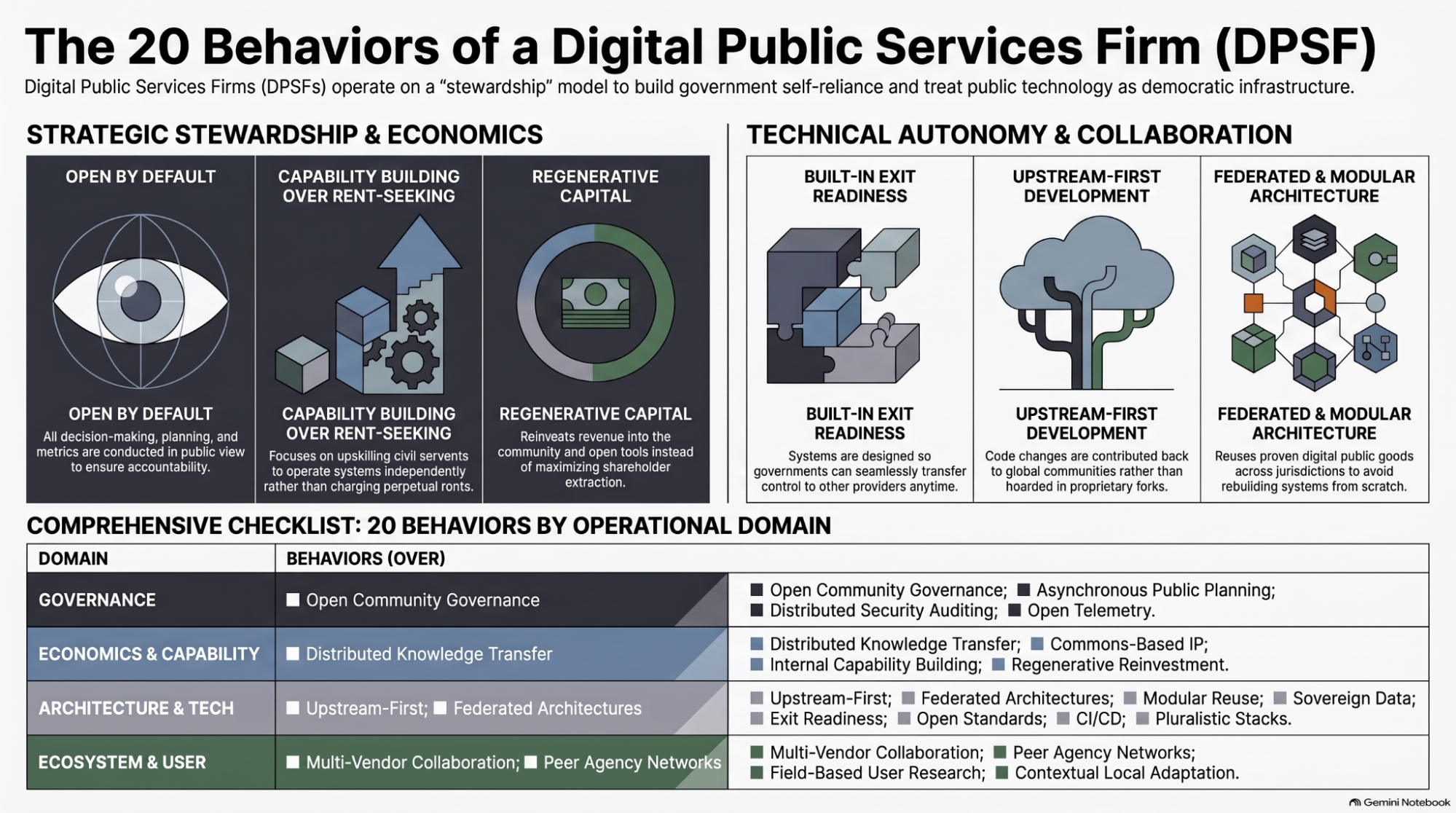
A Digital Public Services Firm operates with a fundamentally different organizational DNA rooted in trust and stewardship. Its culture prioritizes civic capacity-building, open collaboration, and public interest alignment over value extraction. Where a traditional firm seeks to own the solution and secure recurring contracts, these firms build government self-reliance. Because their incentives align directly with the public good, they could benefit from a distinct classification.
To build public trust, you must build in public. These firms describe themselves as open by default. Their operational model is built directly upon the foundation of the four freedoms of free software - the freedom to run, study, redistribute, and improve software - and guided by the four opens: open source, open design, open development, and open community.
When all work is open by default from day one, citizens and independent auditors can verify how algorithms work, how design decisions were made, data is handled, and where public funds are spent. Openness replaces blind faith with verifiable evidence.
The mission of a Digital Public Services Firm is to cultivate public technology as democratic infrastructure rather than a commercial commodity. Rather than trapping citizen services and data in proprietary silos, these firms act as a bridge between public sector needs and upstream Free and Open Source Software (FOSS) and Digital Public Goods (DPG) communities.
The ultimate expression of trust in this model is "exit readiness." A Digital Public Services Firm deliberately designs and engineers systems, codebases, and documentation so cleanly that the government can seamlessly transfer operational control to an in-house team or another provider at any time. By eliminating fear of vendor lock-in, they prove that their partnership is based on performance and integrity, not entrapment.
We - the firms that operate this way - are no longer working in isolation. What began as quiet, distributed practices has gained undeniable momentum. As public trust erodes and the failures of black-box vendor contracts become impossible to ignore, government leaders are actively searching for technology partners rooted in openness, security, and stewardship.
To accelerate our impact without building bureaucratic, centralized alliances, it is time to scale through open protocols. By adopting shared, machine-readable specifications - such as publiccode.yml metadata, OpenSSF security scorecards, and collaborating with our public sector clients to publish verifiable evidence of the DPSF behaviors listed above - we make our alignment automatically discoverable to government digital marketplaces and public code registries. Releasing and stewarding our business knowledge: internal playbooks, legal templates, bidding strategies, and handover documentation from day one makes it more efficient for all of us to adopt these behaviors asynchronously.
Equally important, we must proactively reach out to Digital Public Services Firms that we compete with. By collaborating more deeply and sharing knowledge, we can better guide our government clients toward wiser technology and procurement choices. Together, by forging strong, decentralized networks of aligned firms, we can rebuild digital public infrastructure on open foundations - systematically replacing the legacy vendors who have used their massive scale to capture public institutions.
Reach out to other firms, and/or join us, to collaborate: info@dpsf.cc
This article is available under a Creative Commons Attribution Share Alike License 4.0 International.